
Have you been putting yourself out there but still feel alone?
Do you have social connections but they feel ‘surfacey’?
Do you wonder why you feel lonely when you know you have strong social skills?

About one half of adults in the USA report feeling lonely or isolated, leading to the declaration of a public health epidemic. Why was this considered a health issue? Because research identified health risks of loneliness on par with smoking 15 cigarettes a day! Most of us would avoid such a risk but yet – half of those in the US are walking around with 26% greater risk of premature death, 30% greater risk of heart disease or stroke, and a 50% greater risk of dementia as we age. Lonely adults face double the risk of depression and anxiety. Across the globe, one in six people experience significant loneliness leading the World Health Organization to also declare this a critical public health concern. In the US, up to 80% of young adults between the ages of 18 and 24 report feeling lonely. Clearly, we have a serious problem on our hands and if you have been struggling with feelings of loneliness, you are not the problem.
How did we get here? Everyone has an opinion. Anthropologists might point to the progression of individualistic cultures as people moved into cities and away from family/collective cultural structures. Sociologists might point to the replacement of face to face connection with technology-based interactions. Those of us in the psychology fields have been watching a complete breakdown of the social contract between employer and employee, making folks subject to frequent relocation or the gig hustle, leaving little financial and situational stability to invest in relationships. We have also observed the still lingering effects of a global pandemic. Not paying attention to these systemic details can leave the lonely person even more discouraged as they blame themselves for their lack of community. The last thing you need is self condemnation when you’re already struggling. Working harder to make connections isn’t the answer, working smarter is.
We can’t control the systemic dynamics that isolate us. What we do have influence over is our internal worlds and this is where the magic is. Everybody loves a quick fix but when you are staring down the barrel of isolation, weak connections or a wake of dysfunctional relationships, a new skill isn’t necessarily going to cut it. ‘Putting ourselves out there’ isn’t enough on its own and for those who have been doing that and wondering why they still feel alone, stay with me. What is the smartest strategy when there are so many things working against us?
If the world of healthy connection is fraught with hindrances, an efficient approach is to show up in the best possible condition to take advantage of opportunities. The reality is, if loneliness has reached epidemic levels, that means there are many, many prospects available for connection, right? Shouldn’t that lead to an organic resolution of the problem? Not if we’re all bumping into each other with little capacity to build bonds that hold. The reality is, many of us grew up in family systems that did not teach us how to build healthy relational bonds. Maybe you had a ‘wonderful childhood’ with parents who cared, food on the table and fun activities but did you have:
- Parents who knew what you were feeling even if you didn’t share?
- Comfort, care and kindness when you were upset?
- Space to share your difficult emotions?
- Parents who truly worked to know you as your own person and engage with your heart?
- Parents who would co-regulate your nervous system when you were distressed?
- Parents who owned and worked to rectify their mistakes with you? (Modeling how to repair relationships)
These are the things we needed* – consistently and a majority of the time (there is no such thing as perfectly) to be well equipped for building healthy connections as adults. Some of you already knew you lost out because your childhood had some level of trauma. For many others, this perspective is a surprise but may finally address why things have just not come together relationally for you. So here’s the strategy: focus on building out your internal relational world first. You are not the problem but you can increase your odds of success in a broken system.
The foundational requirement is to understand your story. How did you learn to connect with others? What training did you receive on what to look for in relationships and how to react to various relational dynamics? What gaps were you left with? Once you understand your story, next comes learning how to grieve the losses you have identified. Unresolved grief drives dysfunctional relational patterns as we seek to replicate or avoid the losses we have not confronted. Facing our grief builds the muscles we need to name, learn from, express and regulate our emotions; essential relational skills. If we do not know what to do with our own internal worlds, we cannot deeply connect with others. Understanding our story and facing our losses teaches us who we are, what matters to us and therefore, what boundaries we need to operate with in relationships. From this place of self awareness and self regulation, we can implement the principles of good communication to cultivate healthy relationships.
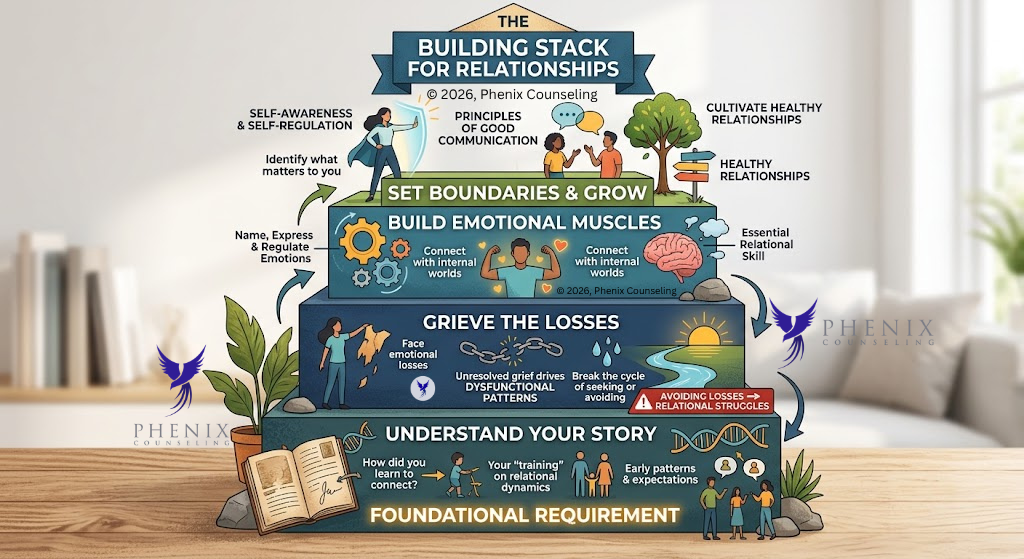
© 2026, Phenix Counseling. Sale, distribution, or use in whole or part for anything beyond this blog post is strictly prohibited.
Looking at this graphic, you may realize that you’ve tried to start from the top down. Sometimes that leads to immediate gains but often, the cracks return over the long term. We have found the sustainable path starts from the bottom up. Build a strong foundation and everything above holds true over time. This is how we guide clients through transformation here at Phenix because we believe that every life struggle is rooted in relationship: with self, God or others. No matter where the relational break is, this path offers a way through the wilderness, to the ‘land’ of healthy connection. Therapy isn’t the only option so use this framework to consider a relational stack building approach that works for you. In the meantime, we are working on a special project to make this process more accessible to everyone!
*Taken from Adam Young’s Big 6 teaching
