Service…it’s who we are!

Service…it’s who we are!

How did we end up in downtown Orlando, in the oppressive heat during the middle of a pandemic?

Well.  Phenix Counseling was founded with a commitment to service.  While we recognize the value of the knowledge and skill we bring to the table, expecting that the worker is worthy of their wage, we have always been mindful of the fact that access to quality mental health care is a major problem.  In response, Phenix committed to funneling 10% of profits into a scholarship fund to provide care to those who cannot afford it.  Our regular fees were set to make services accessible to working individuals and in the future, student interns will be acquired to provide quality care for even less.  Additionally, every Phenix counselor always maintains one community client who pays only what they can afford – as their way of giving back.  However, when COVID blasted on to the scene a mere three months after the group practice launch, our grand philanthropy plans had to be set aside as the financial focus became simply survival.  Still….our hearts broke as we looked around at the fallout and wondered what we could do to be there for our community.  Despite our own personal financial fears, all three of us agreed to set aside our fees for one week (March 8th – 14th) to go toward a special COVID fund that would be utilized to assist community recovery once the stay at home order was lifted.  Justin had visions of handing out food…I thought perhaps gas cards to help folks drive back to work after prolonged furlough.  As everyone knows, things have not been that simple.  Here it is July and the virus has not lifted.  In fact, the numbers are worse than ever.  That magical moment of “getting back to normal” has not arrived.  I began to ponder what we should do with the money we had earmarked.

It was during that questioning when I came across this video:

I knew Eric!  He was the sweet young man who had contacted me a couple of weeks before I left for Greece last year because he wanted to surprise my student with a proposal 🙂 .  I also knew of the organization he led and the good work they did.  Something clicked.  Here was a mission we could be confident supporting.  We are holistic providers; we don’t just attend to our clients’ mental health.  We recognize that everything is connected: body, soul, spirit.  That’s why Justin does adventure therapy which provides physical challenges, Caitlin utilizes dance and I am currently finishing up a certification in yoga.  What better alignment with our commitment than to contribute to the basic physical needs which directly affect a person’s mental and emotional health?  I brought the idea to the team and they enthusiastically agreed…but I felt convicted that this wasn’t just to be a monetary thing.  Justin had challenged us from the very beginning to be “boots on the ground” in our community and SALT was calling out for volunteers.  So, with no small amount of discomfort, we signed up to serve.  We have minimized excursions and worn masks consistently throughout the debates.  It was intimidating to consider serving a population who could reasonably be expected to have COVID exposure.  But if everyone was hindered by that concern, then who would serve?  How would they get the care they so desperately needed?  Once again, our decision to go fully virtual was a blessing as we could confidently take on this mission without the concern that our clients might be negatively impacted.

That’s how we ended up in the Florida heat on July 5th, organizing clothes for handing out to friends (what SALT calls the folks living in homelessness who show up), taking requests for clothing needs/sizes, talking with these friends and managing the inevitable conflicts brought on by heat and emotional/mental distress.   I cannot recommend this mission enough!  It is sobering to think about how exhausting it was to handle four hours of serving downtown while our new friends live in its elements every.single.day.

Therapy is an investment.  For many, it is an investment made with sacrifice.  We think it is important for Phenix friends to know that when you invest in your health with us, not only do you (and the loved ones connected to you) benefit, but your community benefits as well through our commitment to pay it forward!

If you would like to follow our lead, SALT is always in need of volunteers.  You need no special skill or talent (though barbers/hairstylists are sorely needed)…just a willingness to show love.  If you want to be of help but have health vulnerabilities – consider preparing lunch for the friends and volunteers and simply dropping it off on one of the service days.

Here’s the link for info about volunteering

Here’s the link for info about providing a meal

Online Adventures

Over the years, I’ve worked with a number of therapists, beginning with a licensed social worker who was also a pastor at a local church.  Each one has walked a specific section of my journey with me, facilitating insight and clarity along the way.  Soon after arriving in Orlando, I worked with two different therapists during an exceedingly challenging time of my life.  As I ended 2017 in perhaps the best mental and emotional state I had experienced in years, I paradoxically sensed it was a good time to re-enter therapy.  I was facing several positive transitions and believed I had the emotional energy to tackle foundational concepts that would help me live life from the best level possible.  Though I did not have really specific issues I needed to resolve, I did know I wanted someone who would be able to sit with and explore whatever emerged.  Trouble was, all the therapists I knew who worked like that were my friends and so could not serve in this role.  My inquires for referrals turned up absolutely nothing that met my criteria.

I remembered one of my interns telling me he had experienced useful sessions online with Victor Yalom, the son of another therapist – Irwin Yalom who I admire in my approach to therapy – especially group work.  However, I had a skeptical view of online therapy:  I’m relational in my theoretical orientation – how on earth could there be great therapy in the absence of smell, touch, and the extra-sensory dynamics of physical presence I had come to rely on in terms of perceiving what clients were feeling?  As time wore on with no emerging options, I decided it couldn’t hurt to pursue the idea, even as a second-best one, and so I contacted Victor.  Many steps later, I started working with a therapist he recommended who lived in Paris – Anastasia – in January of 2018 and it was definitely the right decision!  Here was a humbling example of what I was teaching my students: Anastasia’s ability to connect with me, to hear what I wasn’t saying, to see the patterns beneath the stories I shared, mattered more than the method we were using to talk to each other. Yes, online therapy has its differences but what mattered was the therapist and his/her ability to build a relationship with the client regardless.  Wow!

Over the following months, I put aside my biases toward online therapy and considered its benefits: to English speakers living in non-English speaking countries, to individuals committed to deeper work but lacking therapy professionals in their part of the world, to my local clients with chronic illness who sometimes struggle to make it in to the office, to individuals like me across the state of FL who are looking for a specific therapeutic fit that they cannot find close by.

I happened to be visiting Paris some time later and so I had a session in person with Anastasia. I was shocked to find that it did not feel much different from the sessions we had been doing online. It was the final push I needed to start offering what I have received: greater accessibility to this business of going deeper.  I believe my experience as an online therapy client with a therapist who does it excellently is the best qualifier for providing this service but I am still pursuing specific training and education in this particular modality to ensure that I continue to grow.

2022 edit: How could I have known the benefit of this expansion?  It prepared us to transition to a fully online practice in March of 2020!  When you engage teletherapy with Phenix, you work with a team who truly believe in this modality.  Teletherapy offers major benefits when we are willing to explore the possibilities.  Your Phenix therapists have pursued the experiences and training necessary to maximize this exciting change in how healthcare is delivered.

Business Success

We are in a season of business volatility, do I have time to worry about healthy organizational culture?

**This is the second in a two part series.  Click here to read the first post.***

Intelligence and knowledge are so common these days that we can’t trade on just those anymore.  Emotional intelligence, applied to corporate culture design is the factor that sets you apart and is the key to longevity.  In part one of this series, we defined business smarts as the usual trifecta: strategy, marketing and finance.  ‘Smarts’ gets you in the door.  Let us not minimize that.  However, you need emotional intelligence to work the room.  Here’s the cool thing: learning requires clarity and interest so organizations that focus on health automatically get smarter.  Whaat?!  Think about the airline in part one’s story.  Their company has the smarts but smarter does not automatically lead to healthier since we are typically relying on expertise rather than creativity and relationships.  It’s like a bank safe full of cash (smarts).  Organizational health is the combination to access the safe.

Organizational health is an integrated and intentional approach to the things we already know matter, but usually attend to in isolation: team building, strategic planning, productive meetings.  Reflect on my airline fiasco story from part one.  Can you fathom the losses leaking from the bottom line daily?  (Every member of our group ended up with a $500 flight credit.  A credit I was loathe to use as I NEVER wanted to sit on one of their planes ever again).  Organizational health is ridiculously expensive to ignore!  More importantly, the physical, emotional and mental toll on you when you work in an unhealthy culture is far too high a price to pay for short term gains.

The corporate landscape has shifted dramatically in the past few years.  Obsession with bottom line maximization at any cost, rooted in runaway greed and/or perceived scarcity has infiltrated the business world from billion dollar corporations to small businesses.  Add to that, the unknowns of AI integration and we are facing years of turbulent adjustment and transition.  Owners and C-suite members face a choice: short term gains or long term sustainability.  Run with the strategies of the moment and grab every dollar you can because tomorrow isn’t guaranteed or slow down, prioritize sustainability and outlast the chaos.  BOTH smarts and emotional intelligence are key to survival in the long term.  Strategy, marketing and finance define your business’ ability to live to fight another day.  Emotional intelligence gives you an asset that transcends every trend and fad.  It prioritizes human resource – the key component of longevity.  After all, without humans, we have no customers and customers will crave and prioritize human connection more and more as we fall deeper into the black hole of technology.  If you want to be one of those still standing when the industry house of cards topples, tending to organizational health is your secret weapon.

As a counselor dedicated to holistic health – this is the factor that drives my passion for helping businesses design a healthy culture.  Combine that with my 15 years in the corporate world in various positions of leadership, several years of higher education leadership plus years as a successful business owner and you have a uniquely qualified individual who understands both the business and psychological components of organizational culture.  The fact that healthy organizations are more likely to increase productivity and profit is a nice bonus that pays the bills for all of us 🙂

To learn more about organizational health – check out this great resource:


Let’s talk business

What is “organizational culture”?

Why does it matter?

**This is the first of a two part series.  Link to the second post is at the bottom.**

After 30 minutes on the plane, we were all asked to get off as the mechanical problem identified needed further attention.  We were a band of 25 people from Orlando heading to a connecting flight in Newark that would take us to the other side of the world for a study abroad course.  This was not a great way to begin our adventure.  When the plane was still unfixed a couple hours later, tensions rose.  We began to abandon hope that we would be able to continue on together.  However, as negotiations began, to figure out how to get all of our members across the Atlantic, employees insisted that since our tickets had been booked as a group – they could not break up the reservation to split the group onto available flights.  This, despite the very real mathematical problem of ZERO flights heading into Greece with 25 open seats over the next several days.  The story is long and epic so I’ll offer the low-lights:

  • Due to employees’ inability to use common sense and creatively problem-solve, several flight opportunities passed before they finally realized they would have to split the group.  One half was put on a plane to a connecting city.  The other half was placed in a hotel for the night which turned out to have trouble with running water.  The staff at the hotel commented that they are forever housing ‘refugees’ from this airline.
  • When the second group boarded their plane the next morning, they again had to deplane when a mechanical problem was once again identified.  They eventually left on a different plane.
  • Both groups upon arrival in Frankfurt found that their reservation had not been properly transferred to the partner airline that was rescuing the flights and so they had no seats booked to our destination.  Thankfully, this new airline did have a different organizational culture and a few nail-biting hours later, managed to book seats for every person….except one who ended up having to wait alone in a foreign airport for a later flight.  It just so happened that she was the one student who had expressed a mortal fear of being separated from the group because on a trip she had taken in undergrad, a classmate was separated from the group and found murdered.  We begged and pleaded for someone else to be left behind but already taxed by their efforts to fix the ticketing problem, they explained that because the original airline had not broken up the group booking in their system – they were unable to switch out any individual tickets.

This particular airline has been in the news numerous times over the past few years for GROSS mis-steps resulting in severe consequences.  They are a perfect illustration of poor organizational health manifested in high turnover, low productivity (major fleet issues), politics which prevent employees from having the freedom to problem solve, confusion and low morale.  The employees we encountered were clearly unhappy and we could not blame them.  The public remains puzzled as to how these problems continue.  A closer look at the players reveal experts in all the usual concerns: marketing, finance and strategy.  Clearly, the problem is not smarts.  So what is it?

Organizational health.  I’m not talking bean bag chairs and napping rooms here.  It’s hard to describe; difficult to measure objectively, but you KNOW when it’s good (Southwest) and you KNOW when it’s bad (the airline we were on).  It’s a simple concept but it’s incredibly complex to implement.  Finance, Strategy and Marketing (smarts) are the what.  Organizational health is the how.  The way in which you implement and maintain budgetary management, goal setting, and telling the corporate story – that is organizational health.  That strays into emotional and awkward territory which is why it is typically skirted over in management schools (or spoken of largely in intellectual terms) and avoided by most managers/leaders.  Problem is, as organizational culture expert – Patrick Lencioni asserts: sustainable success is impossible without BOTH smarts AND health.  Business leaders may want to stay in their ‘smart’ comfort zone but guess what?

IMG_0383.JPG

Intrigued?  Interested in learning what this looks like and how it applies to you?  Stay tuned tomorrow for more…

Part Two


Whitespace

At the GLS event I mentioned a couple of months ago, I heard Juliet Funt speak on the concept of “whitespace“: that business of intentionally creating a space for NOTHING so that creativity can emerge in the workplace.  An excellent reminder and validation of my love for this concept in our personal lives.  Our culture is driven by the need for constant activity and most of us are completely enslaved to the merry go round.  There are two main traps we tend to fall in for this obsession with activity: The trap of achievement – believing that we are only as worthwhile as our productivity…hence there’s never a time we can feel at peace when we are still.  Or, there is the trap of emotional avoidance.  Sitting still becomes a dangerous dynamic to be avoided at all cost because it allows one’s pain and anxiety to emerge!   Often, you’ll hear folks caught in these traps exclaim, “Oh, I have no time for that”, or “Oh my goodness, I would go crazy sitting around doing nothing” when presented with the idea of rest, retreat, white-space.  I chuckle internally when I hear these tell-tale words.

The reality is, we absolutely need quiet time in order to grow.  There’s the irony – so often, we go, go, go because we’re trying to achieve, to progress, to accomplish.  All the while, in the absence of appropriate down-time, we’re actually moving backward.  Often, without realizing it until it’s too late.  The epiphany typically arrives in the form of physical illness because our bodies keep score and when we ignore it’s need to rest and recuperate, it eventually takes its revenge.

My focus today though is the emotional aspect.  This blog is about personal transformation.  With that in mind, where does white-space fit in?  Transformation begins with awareness, continues with learning and is then cemented by action.  In order for new learning to be integrated, it must be consolidated – a process that cannot happen during activity.  It only happens during times of quiet.  Have you ever noticed that you attend an amazing workshop where you learn great concepts but weeks later, you’re struggling to remember what you found so revolutionary?  Or, perhaps you pulled an all-nighter in college, studying for a big test and then drew a complete blank on so much during the exam?  These are examples of what happens to learning without white-space.  If we do not take the time to STOP and reflect on our new awareness, understanding and insight, we don’t retain it.  We don’t act upon concepts we don’t retain and thus, we stay stuck in patterns of dysfunction.

When clients have covered a lot of territory in session, I always warn them to take some downtime within the next 24 hours to let their work consolidate.  Eventually, I teach them to build this space into their regular routine so that there is ongoing room to grow and they don’t have to scramble for it when life brings them new opportunities.  Personally, I try to model this in my own life, regularly spending time in nature.  This week, during a quick trip to GA, I asked my host about the local parks and was guided to a fabulous nature trail.  My friend and I remarked how just one hour on the trail made such a difference in our mental outlooks…not to mention how much better our bodies felt after hours of driving the day before.

You may find yourself resonating with these words, making promises to yourself to find more white-space in your life but if you are caught in one of the two traps I mentioned, it’s easier said than done.  Your source of worthiness must be addressed if you are to ever make peace with stillness.  You must acquire the skills of emotion management if you are to become willing to let frightening feelings emerge.  Likely, you have specific family stories that have left you ill-equipped or believing lies that will forever hold you back.  If you don’t know how to work on cars, don’t you take your vehicle to a mechanic?  If you never learned to work on appliances, don’t you call a repair company for your broken refrigerator?  Yet somehow, when we recognize a gap in our mental or emotional skills, we hesitate to contact a therapist who is trained in the very skills we lack.  Strange, isn’t it?  Consider breaking that trend and give us a call if you realize your struggle to create white-space goes deep into territory you haven’t yet mastered!

“Safe” People

I actually don’t like that term “safe” since it’s definition is: absence of risk. We all know that no part of life meets that definition. I think we’ll go with “safer” people. The concept has been mentioned in previous posts so I thought it time to focus on what I mean by this business of finding and connecting with safer others as we work on our own personal transformations.

You know that cliche phrase, “birds of a feather flock together”? It’s a cliche because it’s true. We attract the sort of people who match our dysfunctions. They either play the complementary role or share similar behaviors. Makes sense that as we address our dysfunctions, we would see increased conflict with our fellow birds, unless they too are willing to transform. As I mentioned in my last post, once we get past the grief of recognizing some birds will be left behind, we face the dilemma of finding new ones. How do we avoid collecting more of the same? How do we identify that which is healthier when we are in the midst of still figuring out our own healthy? There are three components which have emerged over the years in my own life as I am blessed with a tribe of safer people.

Presence
Safer people have worked on their own dysfunctions to the point that they are able to focus fully outside of themselves when they are with others. They aren’t perfect but because they’ve taken a long, hard look at their own pain, they don’t retreat into it or project it on to you when your pain surfaces. When we are with these folks, we feel connected and that their attention is focused primarily on us.

Love
This is such an overused word – it has lost specific meaning in our world. In this context, I want to define the word as ‘valuing the other’. When someone values you, they consider the ways in which they speak to and treat you. They make every effort to tangibly demonstrate care and concern; they listen to understand instead of to simply respond. Since they’ve worked on themselves, they’re well aware of their own shadow and so they offer grace for yours. Not that they allow themselves to be taken advantage of, but they don’t shame or condemn.

Keeping it real
Here’s another abused phrase. It has become a way to excuse being a jerk. It’s right up there with, “I’m brutally honest”. That’s not what I’m going for here. What I’m talking about is the person who will be authentic with you. They share their real selves and they tell you honestly, how they are affected by you and how they truly feel. So, once again, safer people don’t avoid confrontation, they don’t allow themselves to be bullied – instead, they find healthy ways to communicate what’s really going on. Because they have established their acceptance of us, we are able to hear these difficult truths and use them in our transformation process.

Hopefully, this begins to ‘flesh out’ the safer people we need to be looking for and gives you a matrix to evaluate the folks already in your life, the new ones you meet and most of all, yourself! For further study – check out Cloud and Townsend’s excellent book on this subject. Books are wonderful but they don’t hold our hands and walk us through so find a wilderness guide to help you if you’re struggling.

Every day I’m hustlin’

codependent

[koh-di-penduh-nt] See more synonyms on Thesaurus.com
Adjective 1.
of or relating to a relationship in which one person is physically or psychologically addicted, as to alcohol or gambling, and the other person is psychologically dependent on the first in an unhealthy way.
Noun 2.
one who is codependent or in a codependent relationship.

“Codependent” is so overused at this point and has come to mean just about any version of an unhealthy relationship.  I want to use a different term – one I’m borrowing from Brene Brown’s vernacular…she calls it hustling for love.

I’m referring to this business of denying or minimizing self in order to be, do or say what another person wants.  We take care of things the other should be handling in order to make ourselves indispensable.  We hustle like this because we want to be loved.  We don’t trust that we will be loved as we truly are and so we put on masks, we become something we are not, we enable, in order to be what we think will be loved.  The problem with all of this though is that when love comes our way, only our false self can receive it.  Underneath, our true self never receives love and so we spend our lives unfulfilled and lonely, even in the presence of loving others.

The issue has been top of mind lately due to many conversations with a friend who has been focusing on this in his life.  What we have taken great notice of is the fact that once awareness is gained, once root issues of self worth are tackled, the ultimate step of healing involves doing: engaging relationships from one’s new position of awareness and worth.  But what if you don’t have any “others” in your life, qualified to take the journey with you?  What if you have only gathered others who need a hustler?  Who don’t know what to do with an authentic self?  This is an issue we don’t often see anyone discussing.  All the books and articles focus on what needs to change within us and how to behave differently, but I haven’t found anyone discussing the others.  So here goes:

  • When we begin the work of examining the way we relate to others and the roots of those relational styles, we must also begin the work of identifying the characteristics of healthy “others”.  Many of us have not been exposed to enough examples.
  • We need to also brainstorm where healthy others can be found and begin to position ourselves accordingly.  This may mean new social activities or increased involvement in groups we previously marginalized.
  • We need to communicate every step of our journey to existing, important others in our lives so that they have the opportunity to come along, to adjust to who we are becoming.  If we don’t communicate, we leave them confused, defensive and possibly hurt by our internal changes.
  • “We are not ourselves by ourselves” says Peterson.  These efforts to transform our social circle will go a long way in our own self knowledge as we bring stories from our interactions into counseling.  It is a key experiential aspect of therapy!
  • When we have achieved enough awareness and worked through some of the core issues of self worth, it is time to identify a couple of healthy others in our sphere with whom we can practice being our newly authentic selves.
  • From this point forward, it is all about relating in likely opposite ways to how we have before.  It is intentional and consistent.  This process needs to be a regular topic of counseling so that there is a constant feedback loop for learning.  It is a terrifying challenge but it is the final step in true transformation.  There is no other way to permanently change the meanings we have made of life experiences.  It is a messy business filled with mis-steps requiring honest communication from which to recover.  We may need to make a few changes in who we include in our tribe which then involves a grieving process for the ones who simply do not have what it takes to enter this new territory with us.  The payoff is a level of connection and relational joy we never thought possible.  Benefits that cannot be achieved with solely internal peace and knowledge.

Now it’s your turn…What aspect of mental/emotional health is on your mind these days?  What are you currently wrestling with?  I want this space to be useful!  I’m also considering doing a weekly Facebook Live which will focus on what YOU want to hear about, so give me your feedback.

Storm Sanity

I live in Orlando and so I am sitting here looking at reports showing Irma’s path headed directly toward us.  As I scan my social media news-feeds and talk to loved ones, it is clear that anxiety is high and coping skills are a must if we don’t want to end up losing a lot of sanity ground by the time this is all over.  I thought it would be helpful to explore ways to maintain our mental/emotional health through this storm.

As soon as you figure out where you will spend the storm – in place, at a shelter, with friends or completely out of town – make a plan for maintaining good sleep, nutrition and movement.  These are the first things to go in circumstances like these…we eat food that leaves us feeling terrible, barely move and sleep either too much or too little.  It just happens because we get caught up in the urgency of the moments and/or the confusion of the aftermath.  Make sure you have food options on hand that make your body feel good, figure out a reasonable sleep schedule you can stick to throughout your stay and brainstorm ways to get some movement in every day – whether it’s using the (non-electric) equipment you have in place, simple callisthenic movements like jumping jacks or adventure walks outside once the storm clears.  Get on Pinterest now while you can to find movement ideas that will work with the circumstances you’re in.

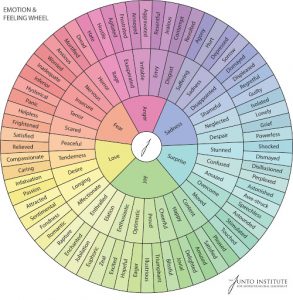
Make sure you have resources and materials in place to manage your emotions.  How do you think you will feel during this experience?  What are the things you normally need when you feel like that?  (Art supplies, journals, stress balls, stuffed animals, pets, etc.?) How can you adjust those strategies to your lock-down situation?  When you are stressed, upset or overwhelmed, you will not have the mental resources to figure these things out.  Do it now so you have a plan to express and manage your emotions.  Here’s a worksheet you may find helpful:

emotion management

This is not the time to play lone ranger.  Reach out.  Arrange to be with others throughout this experience if at all possible.  Don’t assume that family is your only option if you know they drive you crazy on a regular day.  Can you imagine being locked up with them for days in a stressful situation?  Think about your social circle…Who are the healthiest people in your life?  Gravitate to them first.  Yes, take some time each day to be alone…to breathe and to think but make sure you stay connected to share your thoughts and feelings with others.

Finally, pay attention to what you expose your mind to.  Limit time on social media if it is filled with folks in a frenzy.  Watch the news/weather channel only long enough to hear time estimates of the storm’s approach.  Do internet searches for any specific information you may need for your preparation efforts – rather than watching TV endlessly, waiting to learn “everything”.  Avoid conversations with those who will only increase your stress and anxiety about this storm.  Decide now what reasonable truths you need to focus on.  Find resources that will align with those truths – write them down if you have to….whatever you have to do to ensure that what is coming at you repeatedly will be functional, encouraging and helpful!


The mechanics of change

I am sitting in a hostel in Brussels, Belgium at this moment – taking some down time to rest before heading out for the evening.  I’ve been away from home now for four weeks and I can definitely testify that leaving one’s comfort zone for extended periods of time facilitates much internal transformation.  Next week, I’ll write more specifically about that.

Today, I’m reflecting on a conversation I recently had with my travel companion about the process of change.  When we decide to renovate some major area of our lives, what does that look like from the inside?  Going to a counselor is usually reserved for more significant repairs, so this question would certainly pertain to current or future clients.  I answered from my own personal experience though.  One of the core values of Phenix Counseling is that I cannot take anyone where I have not personally gone (in terms of the process of facing our own shadow selves).

So for me, it begins with awareness.  Recognizing not only the problem, but also (usually with the help of another), how I am contributing to the problem.  What is it about me exactly that is facilitating the pattern and how did I come to be that way?  I need this insight in order to have productive conversations with myself and that is pretty much the meat and potatoes of the change process for me.  Let me break it down:

  • When I figure out the past experiences that led to my current way of approaching things and what meanings I made of those past experiences, I can choose a new perspective that will give me the motivation and logic to take a different path in the here and now.
  • Looking at the question of – how did I come to be this way…why am I behaving dysfunctionally – helps me understand myself enough to figure out what need I’m trying to meet.  I have to brainstorm ways to meet that need in a healthier way if I am to have any hope of success. I turn these ideas into practical plans: what will do instead, when and how will I make that happen?
  • Then….the rubber meets the road.  Real life sets in and change comes down to tiny moments of decision we face in the everyday.  Here’s where that constant conversation with self comes in.  It’s a messy process and it took me a little while to try and explain it.  At first, I catch myself “after the fact”.  I resort to my old ways but at least I realize it soon after.  Then…I start to catch myself during the process.  I remember when I decided to relate to my husband differently, there were times when words from my old perspective would be coming out of my mouth but in my head I would be thinking, “you need to stop talking”.  Yet somehow…the word vomit continued and I was faced with cleaning up the mess afterward.  Then comes the ability to choose my new strategies before I mess it up.  This begins to happen more often than not until I solidify my new way of being.

Of course, it never happens in this linear fashion – I circle around and through these stages in no particular order until I establish some sort of stability.  Oh how I wish it was like the one-way journey of the caterpillar to the butterfly!  All of this has to happen within the context (cocoon) of others who can help me analyze and assess my thoughts and behaviors throughout the process and with folks who have the patience and ego strength to be on the receiving end of my changes.  I am blessed to have that kind of environment and often, I find the greatest work in therapy is helping my clients build such a support system before they can tackle the things they need to change within themselves.

I hope this little window into my world helps those who struggle to become who they are meant to be.  Our journeys are unique – others would describe their process differently but I believe the commonalities are the mess and the time it takes to cross the desert of transformation – it’s always longer than we planned.  Wherever you are in that trip, be encouraged and don’t skimp on the task of ensuring you have solid travel partners!

Necessary Endings

I stole the title of this post from a great book.  It perfectly captures a phenomenon I’ve been living out personally and that I see in the lives of my clients quite often: This business of hanging on to relationships far beyond their expiration date.

Why do we do this?  The short answer is fear, but let’s break it down more specifically:

Fear of rejection: how many times do we fail to set boundaries, fail to verbalize what is ok or not ok for us because we are afraid that when we do that, the other will reject us? They will not want to be in relationship with us.  Which leads us to the next fear…

Fear of being alone: many of us believe that anyone is better than no one.  We cannot fathom how we could ever be happy by ourselves and so we tolerate all kinds of shenanigans because we cannot be alone.

Fear of violating our responsibility or duty: For a million and one reasons, we feel obligated to the other to “help” them and/or not abandon them.  Anything from blood ties to our own sense of ethics to nice things they did in the past.  Whatever the reason, we use it to justify staying in the relationship because we “have” to.

Fear of hurting another: We are terrified of ever hurting our loved one’s feelings and so we hold back our truth.

So what’s the remedy?

Self worth: when we understand our worth, we cannot help but protect ourselves from dysfunction, even if that results in rejection.  It’s like the difference between a diamond versus a cubic zirconia ring.  The lengths you go to for protection and care of the diamond far exceed that of the CZ ring, simply because of the difference in worth between the two.

Self love: When we take the time to get to know who we truly are and develop compassion and grace toward ourselves, we enjoy our own company…we feel secure in our own skin.  From that place, we realize that while relationships are vital, tolerating any individual who violates our worth is unacceptable and being alone for a season is perfectly fine.

Responsible to, not for: We have a responsibility within our community to monitor our own thoughts, feelings and behaviors to be authentic and kind.  We are never responsible for though – anyone else’s thoughts, feelings or behaviors.  The only partial exception is in our role as parents where we are responsible for them to a certain extent but even in that, our kids have free will to make their own choices and must experience the consequences of those choices if they are to learn how to operate as adults.  There is a big difference between that “to” and “for”, so there is never a situation where it is healthy for us to stick around tolerating dysfunction in order to keep someone from thinking, feeling or behaving a certain way.

Hurt versus harm: When we go to the dentist with a problem, it is pretty much a guarantee that whatever is done to fix us will hurt.  While they make a diligent effort to prevent unnecessary pain, they don’t avoid their work just because some pain will ensue. What they do have to worry about is harming the patient.  If they are negligent or flat out unskilled, they can make mistakes that cause permanent damage to someone’s mouth and that is harmful.  Likewise, when we have to walk away from relationships, there will be hurt and that’s not a bad thing.  What we don’t want is to conduct the leaving in a way that is hateful, disrespectful or deceitful.

These remedies may make all kinds of sense but they are much easier said than done!  Our view of self is rooted in our experiences – particularly those of our early years and it is no small task to change the meanings we have made of those experiences.  Dealing with the inevitable guilt we feel when we begin to set healthy boundaries can be enough to turn us back to our old ways.  If you struggle with taking these steps toward health, seek out a counselor who can help you dive under the struggle to address the foundational meanings driving your resistance!