How to Survive the Holidays Part 2

How to Survive the Holidays Part 2

Welcome back to our holiday survival guide!

Last week, we explored how gaining awareness of ourselves and those around us is crucial in not only surviving the holidays, but thriving. 

This week, we explore the next three guideposts in surviving the holidays.


Guidepost 3: Time to evaluate

There are two main questions for this guidepost:

Was this Thanksgiving break a time of relaxation and reprieve (or did work become the escape)?

Overall, what do you want your holidays to look like? 

Both are great questions as we continue to dive into a holiday experience that brings rejuvenation, rest, and joy. I encourage you to journal or talk to a close friend about your answers here. Take some time and really explore them.

Thanksgiving was probably a good precursor to how the Christmas holidays will go. If it resulted in higher stress for you, this is the perfect time to evaluate what you would like to do for December. How you spend the time during the holidays matters. For many, this is one of the only breaks from work or school that they will receive all year. It is vital that there are some moments of rest.

Which leads me to the next guidepost… 


Guidepost 4: Know yourself and what you need

Here are your two main questions for this guidepost:

How do you recharge during your time off?

What can you add in during the holiday time to assist with that?

Again, Thanksgiving can be a great learning experience. If you felt burnt out or exhausted after this holiday, then you now have the opportunity and time to evaluate. How can you be creative during this upcoming Christmas vacation to add in moments of recharge and rest? 

For the clients I work with, I encourage them to add in moments that incorporate their senses, inner child, and relationships. Let me explain. Your five senses are used daily to experience the world around you. Each of us have things that we love to experience, whether that be through taste, sight, sound, smell, or touch. Adding in moments on a daily basis that bring you joy is so vital to thriving in this life. During the holidays, I know that a walk outside does wonders for my mood and stress levels. I love to hear the birds in the morning and spend time in nature. It helps me focus. For others, it is the feeling of a warm blanket wrapped around them with hot cocoa. 

This then also plays into your inner child. We are all passionate about different things. Incorporate those things this Christmas! Allow your creativity and playfulness to emerge. This can be through decorating the house, getting crafty, or implementing hobbies you enjoy (like baking cookies).

For moments that incorporate relationships, spend time with those around you who build into you, encourage you, and see you for who you are. These are the life giving moments that can happen as you take a walk with a friend, share a good meal with someone, or grab a cup of coffee since it’s freezing out. (Yes, I was born and raised in Florida. I get cold when a breeze blows.)

I would also encourage you to spend time with yourself. This is a relationship that is often neglected but so vital. Take a walk, read a good book, enjoy some yoga, build something new, or tear apart a car. This alone time is also recharging and necessary, just like the relational time with others is. 

And lastly…


Guidepost 5: No.

It’s a complete sentence. You are allowed to say it, especially if an environment, outing, or family member has been shown to be unsafe.

You are not obligated to attend any gathering or talk to every family member.

I know that this goes against so many things you have been told and is uncomfortable to even acknowledge. However, part of thriving during the holiday season is realizing that you can protect yourself, even here. You are worth protecting. (Read that sentence again.) You do not need to relive the childhood trauma you endured because the person who hurt you decided they want you to come for Christmas dinner. 

No is a complete sentence. 


Thanks for joining me on the guideposts to surviving the holiday season.

If you have any other guideposts you would like mentioned or broken down, leave a comment below and I’ll add them into the next post.

I hope you all have a wonderful holiday season!

How to Survive the Holidays (and not end up in jail) Part 1

Welcome one and all to our guide on surviving the holidays! (Part 1)

If you are one of those rare individuals who do not have family drama, conflict, or a long lost relative that chooses to reappear during the holiday season, that’s wonderful. For the majority of the population, the holidays seem to bring something out of those around us that we did not know was there (or that we desperately wanted to forget). Join me as we dive into not only how to survive this holiday season, but thrive. Now, thriving might still look like booking multiple therapy sessions come January, but no jail time is a win.


Guidepost 1: Gaining awareness

For those of you who have been in therapy at Phenix or have seen any of the Justin and Caitlin show (which will be returning for a season 2 btw), you have likely heard of the term “inner child”. For those of you who have not heard of this yet, our “inner child” is a part of us that represents our child self. The child self, when integrated, brings with it joy, spirituality, curiosity, and playfulness.

In general, our inner child loves to idealize situations and people, especially our family. It is an honest and vulnerable part of us that desperately wants our parents’ love, affirmation, and acceptance. For many people, their parents were either unable or unwilling to provide one of those qualities. The holidays then become the perfect time for the inner child to jump on the idealization train and hope that this year will be different. This is why the first step of surviving the holidays is gaining awareness of this tendency from little you. 


There’s nothing morally or inherently wrong with wanting your family’s love and acceptance. We are wired for connection and the foundational connection we crave is from our parents. However, if we continue to idealize the family members every year, we are setting ourselves up for disappointment.

Which leads me to my next guidepost…


Guidepost 2: Gain awareness (of others)

I truly believe people can heal and relationships can be redeemed. With that belief, also comes a hearty dose of reality. Healthy relationships take authenticity and vulnerability, which requires a healthy amount of self awareness and desire to grow from each individual. Unfortunately, many families do not have relationships with each other that would be described as authentic and vulnerable. Gaining awareness of family patterns and dynamics will be vital. Here are some questions to ask:

How do the family members typically react to one another?

Is there a certain family member who consistently creates drama during the holidays?

Who becomes more stressed as Thanksgiving and Christmas inch closer? Why?

Who in the family is safe and healthy to talk to? 

Who models authenticity and vulnerability?

How is the communication level? Do family members actually talk things out peacefully, or are problems avoided until a blow up occurs? (if it ever occurs)

People typically behave in the same patterns until significant work has been done to change and heal. Depending on what you have seen from holidays past, it is a safe bet to assume this holiday will be similar. 

Now that we have a place from which to begin, join me next week as we discuss the action steps you can take to take care of yourself during this time.

Confessions of a Counselor Part 2

I guess I am going to turn this into a mini-series (check back to last week’s blog post). Except, I am not going to a Catholic Priest to confess and then do my penance. I have done that twice in my life though. I was a child and had no idea what I was doing. Had I been going to confession during my late adolescence and 20’s, the congregation may have had to toss me in the holy water fountain and hope for the best. We all have our histories right? Right guys?! Okay, onto the topic at hand. 

Confession #2: There are parts of your dysfunctional behaviors you will keep and that’s a good thing. Wait…what!? Read on…

In therapy you may ask yourself, “Do my dysfunctional coping mechanisms have any redeeming qualities or am I just highlighting it all, hitting the delete button, and starting over?” Good question. And every counselor says, “It depends.” Confession: That’s our go to response. I will say this post is most relevant to those of you who have ventured through the first 2 phases of therapy (awareness and grief), have gotten to the other side (no small feat!), and have begun the process of developing your new story. If you are not at this point in therapy, it’s okay, because if you stay the course this will become relevant to you down the road. 

I started this blog by mentioning dysfunctional coping mechanisms and whether they have to be eliminated completely or not. To simplify this blog, let’s focus this down a bit and highlight codependency as a dysfunctional coping mechanism. 

Codependency is a common struggle for many people. Confession: I am one of these people. Codependency is really centered around a thought and behavior process where you have learned to anticipate other people’s needs, meet them, and forget all about yourself. That is until you are frustrated and become resentful of the person you are rescuing. If you want more on this – come to therapy. 

As you begin to walk out your new story you may think to yourself, ‘Wow, I have to get rid of all this codependent behavior with my new story.’ Well, not so fast. There are gold nuggets and good that can come from even the most traumatic backgrounds. Where codependency falls flat on its face is when you forget about yourself and others’ needs become more important than yours. Well, a focus in therapy would be to learn how to voice yourself and let your needs be known. This is a great and amazing goal because YOU MATTER! The gift you attained with being codependent is that you know how to read people and situations and see what is needed or missing. 

Maybe you recognize a facial expression in somebody ahead of you in line at the grocery store. When they are at the register to pay and you already know the face they are making means they are short money. Maybe you have been there before and maybe now you have the means to pay the difference and be a blessing to that stranger. Your prior codependent skill of anticipating needs will help you in situations like this. How about that person in the office that people tend to take for granted? You notice that, that person has been sad and it looks like they need a pick-me-up. So, you intentionally bring flowers and a card to their desk reminding them they matter. Again, you see the need and the hurt, so you are able to take action when appropriate. 

You see, therapy isn’t a firesale of all things you, but rather a remolding of yourself. The authentic you was/is always there, it just got covered up by life’s unhealthy happenings. Hang in there. Stay the course. Keep writing that new story.

Confessions of a Counselor Part 1

Have you ever wondered what some of the hidden benefits or struggles are with therapy? Have you ever wondered how you came into therapy wanting to reduce anxiety, and a few months later you are grieving losses from your childhood, and seeing the world differently? You see, here at Phenix, we have a strong belief in transformational work, which is why you see the word ‘transformation’ on our website and all our social media accounts. We firmly believe in the process of long-term sustainable growth and change. Not saying there is anything wrong with solution focused approaches, but generally it is not our cup of tea. Within the deconstruction and reconstruction phases of therapy, there are goals put in place by the client. In our field we call this the treatment plan. The treatment plan becomes the flight path for the focus of therapy, but other benefits and challenges come along the way.


So, onto Confession #1


There comes a point in therapy where there is a point of no return. Not that you are forced to continue the process or that you must complete some mandatory journey, rather that your eyes and mind are now more aware than ever. You cannot unsee what you’ve already seen. You cannot unknow what you now know. The joy, pain, and sadness in the world will hit you in new ways and in ways you never thought about. Just because you stop therapy does not mean the new insights stop. 


Since we are heading into the holiday season, let’s use the holidays as the scenery for this first confession. Maybe in years past you have joined your family for Thanksgiving dinner or Christmas Eve adventures, but you never were able to recognize the maladaptive behaviors and functioning of your family of origin like you do now. Maybe you begin to see and sense the sadness in your brother or mom’s eyes, even though they mask it with a smile on their face. These are the things you can no longer unsee and unfeel. Sorry. What you become aware of now causes the brain to create new neural pathways and it becomes a daily part of the ‘scanning’ your mind does. 


It is like the old cliche’ car salespeople use when you are on the lot looking to buy a car from them. They usually say something like this, “You’re gonna be seeing a lot of these on the road.” Yea, that’s because they know your mind is now wired to be looking for the same new car/SUV as you wander down the highway. The car/SUV was always there roaming the roads with you, but they never stuck out to you because your mind never had a reason to cause it to come to your consciousness. Now it does. Has this ever happened to you? Where you went to the Ford dealership to check out a Mustang and now you see every new Ford Mustang on the ride to work. You cannot unsee the Mustangs….they’re everywhere ha. 

Again, my apologies… sorta. Awareness is a part of the journey. Gaining awareness and insight into your functioning is amazing. It gives you the power and control back in your life to begin choosing new ways of responding, behaving, etc. The more you become aware of, the more you can change. The more you realize you can change, the more hope you have of a brighter future, and after the last couple years, I think some extra hope is a good thing. Join me next week for confession #2.

Maximizing Therapy

Person engaging in teletherapy

Have you wondered why excellent therapy can seem expensive?

Do you want to get the most out of the therapy process?

By the time a new therapist graduates from their masters program, they have spent more than 600 hours in graduate level classrooms taking courses dedicated to the art of helping people with life problems.  They have sweated almost 2000 hours on homework and completed 1000 hours of supervised internship.  All at a price tag of over $35,000 (minimum).  Upon graduation, they must work under supervision for at least two years, complete an additional 1500 hours of client service and pass a national competency exam.  When you show up in a therapist’s office, or log on to their teletherapy platform, you are meeting with a highly trained clinician who is there to help you reach your mental, emotional, and relational health goals.

Therapy is an investment in your future.  Since insurance companies will not cover therapy for life issues (there must be a mental health diagnosis), many pay for this vital care out-of-pocket.  Even with support for the cost, there is a significant investment of time establishing rapport with a therapist and digging in to the work.  With that in mind, here are tips for getting the most bang for your ‘buck’!

At Phenix, we generally follow a steady arc in therapy: establishing safety, deconstruction of the old story (how did we get here?), grieving and then constructing the new story.  We’ll look at tips for each stage but before we go there, here’s a foundational principle:

Recognize that therapy is just one hour out of 168 or one hour out of 336 if sessions are biweekly!  Clearly, a lifetime of thinking and behaving a certain way will not be fixed in such short bursts.  That means we must be ready to dedicate time outside of sessions to working on ourselves.

Establishing Safety –

  • Now is the time to be ruthless in clearing off your ‘plate’: Respectfully withdraw from commitments you don’t absolutely have to participate in.  Notify your friends and family that you will not be as available as before.  Setting boundaries poorly may be why you’ve come to therapy so this is a tough one.  Make short term changes (like putting off involvement in something for a few weeks instead of saying “no” all together) which will buy you time to build the muscles you’ll need for more sustainable transformation.
  • Focus on the basics: sleep, nutrition and movement.  Again, the point of therapy may be to get better at self care so take baby steps for now.  Try to get to bed at a consistent time, decide what you need to add to your diet (not take away) to feel good and find movement you actually enjoy – even if it is just for 10 minutes.
  • Be honest with your therapist.  Now is the time to share your concerns so that you can establish a strong working alliance.  They are your guides on what will be a difficult journey at times.  It is important you establish trust in their expertise and skill.
  • Try out the coping skills you and your therapist discuss so that you can determine what works for you and what doesn’t.  You don’t want to wait until you are in the thick of the process to figure this out.  Everybody is different and the possibilities are endless, so there is no substitute for testing things out.

Deconstruction of the old story –

  • Spend time between sessions reflecting on what you have discussed.  Your therapy hour is just the beginning of making sense of your story and connecting the dots as to why you think and/or behave the way you do.
  • Review the material your therapist gives you (books, podcasts, videos, etc.).  This is part of the process for understanding how you got to where you are.

Grieving –

  • Lean in to the discomfort.  This stage takes courage.  This is the stage when clients most often resist the therapist.  Despite the strong alliance they have built and the trust that has been established, all of a sudden, “maybe my therapist isn’t so great after all.  Why are they torturing me with this work?”  Trust the process, it will be worth it!
  • Avoid working on your process after dinnertime each day.  The end of your day should be spent winding down, not opening up Pandora’s box of emotion.
  • Experiment until you find a rhythm of self work time that works for you.  Perhaps a one-and-done session each week when everyone knows not to disturb you or maybe 20 minutes each morning.  It doesn’t matter the format – what matters most is consistency.

Constructing the new story –

  • This stage is about literally rewiring the brain.  That means your efforts will feel awkward and counter-intuitive and that is OK.
  • Your sessions will involve either learning new skills that you will need to cultivate on your own or generating plans for handling situations differently than you have before.  It’s all about action at this point so remind yourself constantly that different results demand different strategies.
  • Practice, practice, practice.  Practice makes progress.  Commit to take one baby step forward each day.  Nothing changes by coming to therapy and talking about it.  It changes when you leave the session and do things differently.  Therapy helps you break this down into manageable baby steps and strategize the most effective changes.

An excellent auto mechanic can easily garner upwards of $100 per hour to fix our cars.  We would consider it foolish to pay for their expertise, then do nothing to maintain the vehicle or prevent further issues.  Our health is far more valuable than our cars so we hope that this post inspires you to invest in yourself and maximize that investment for the best return!


Aggressive Recovery


That’s an aggressive title, isn’t it?

With the world as it currently stands though, the way we recover from the daily chaos, stress, and unknowns has to be aggressive.

It has to be unstoppable.

We have to force through the circumstances of life to find time to take care of ourselves.

We desperately need it.

A common theme in therapy right now is exhaustion. Whether this is physical or more mental and emotional, everyone seems to be exhausted. Like a deep level of exhaustion that we have not known before.

The worse part is, due to how the world is currently going, we feel like we barely have any time to recover from the exhaustion. Days past, then months, then years. We look back and realize we haven’t lived. Just existed.


So how do we change this?


1. Analyze how you are currently recovering on a daily basis. Yes, I said daily. (sometimes hourly) Are there things you do with the sole intent of taking care of your spirit, soul, and body?


2. Find time. Recovery has to be important. The more we put it off and suppress the true nature of what we are going through, the more our body has to hold all of the pain and emotions. At some point, our bodies will shut down from holding too much. Waiting until that moment is not preferable, because it usually includes thousands of dollars in medical bills and a complete stop to our lives.


3. Pick something small. Expecting to drastically change your routine overnight isn’t realistic. That would also add unnecessary pressure to your life. Try just picking one thing that you can add to help with recovering at the end of the day. Below are some suggestions:

Incorporate your body: do something physical! Stretching is a great way to release tension held during the day.

Use your 5 senses: often this will also help ground you if you feel like you are flying on a tornado of life. Incorporate something you enjoy tasting, touching, smelling, hearing, or seeing to provide comfort.

Talk to someone or journal. Sometimes we have to decompress through talking about our days with a loved one or friend. This can help you gain a new perspective or release difficult emotions you may have been holding in.


4. Plan a retreat. I know Andrea and Justin both talked about this a few months ago, but planning some time away from the normal routine can be immensely helpful. This can be a time to intentionally rest, with no to-do list or expectations.


Self care can no longer be optional.

Taking care of our spirits, souls, and bodies has to be a priority. 

We have to fight for ourselves and each other.


Grief – The land between…

Do you wish there was an instant switch from insight to doing life differently? 

Have you ever been stuck in the transition between dysfunction and learning how to live in a new way? 

Back in 2015, I heard Jeff Manion speak on his new book, The Land Between.  I purchased the book at that conference and have referred to his thoughts many times since as I have passed through various transitions.  In therapy at Phenix, we walk our clients through a grieving process after we have deconstructed their story.  As I would explain the process to my clients, I caught myself using that phrase, “the land between” to help them understand where they are in the process.  It finally occurred to me to return to Jeff’s material to see if there were any specific concepts that I could adapt specifically to this grieving process.

Jeff uses the bible story of the Israelites leaving Egypt and the time they spent in the wilderness as the metaphor for his book.  Often, clients come to us because they are ready to leave their Egypt.  As we unpack the story of how they got there, they become more and more convinced that they are done with the dysfunctions of their past.  Treatment planning involves painting the picture of their “promised land” where healthy relationships, living in their calling, pursuing a career they love, intimacy with God, healed mental struggles, strong emotion management or physical ease reigns.  Problem is, a vast wilderness exists between Egypt and the Promised Land and the journey is not linear!

Not only do we need to learn the skills required to thrive in the promised land, we first need to release the waste products of our Egypt.  That is grieving.  The wilderness is necessary.  It is the place we shed our identity as slaves to our family of origin and position ourselves to live as our true selves.  Just like the Israelites…if we skip over the process, we may find ourselves languishing in the wilderness far longer than needed.  As much as grief sounds like the root canal we want to avoid, sustainable living in the promised land demands we move through it.  So, buckle up and let’s review some guiding principles for the journey:

  • Our season of grief is fertile soil for meltdown.  It is likely the main reason why most of us avoid it.  The thought of allowing emotions to emerge can feel too intimidating:  What do we do with the emotions we experience?  What will happen if I express them?  What if they consume me and I can’t function?  Those are the concerns we face together and we equip you with the tools you will need to sit with and actually benefit from, your emotions.
  • Grief is also fertile soil for complaint.  Let’s define that term.  It is not lament – which is pouring out our heart’s emotions.  Complaint is judgement against God, it is implying (or flat out stating), that we were/are better off without God.  Thankfully, God is strong enough to handle our complaints and we specifically hold space for that in therapy if desired.  For those who don’t subscribe to a Higher Power, it is judgment against life itself and the order of things – however we make sense of it.  Complaint resists eviction which is why most of us require assistance for moving it out.
  • Opening hands to release the past makes space for provision.  In therapy, provision looks like mental and emotional space for the new story.  It looks like the skills and mindset needed to enter the promised land.  As we release the self criticism, bitterness, fear and guilt of our old story, provision can look like contentment and strength.
  • Our informed consent disclosure details the risks of therapy – that classic dilemma of, “be careful what you ask for”.  One of those risks is the fact that grieving reveals our own shadow selves, inviting discipline in those areas.  This is often a painful process but it is also a rescue mission, a course correction that calibrates our compass toward our true selves…our purpose.
  • The hope of grief work is transformational growth.  It is the soil God uses to grow the things our hearts desire.  Grieving is the soil for learning to trust because trust is required for thriving in the promised land.  Trust of self, trust of healthy others, trust of God.  Trust pushes out complaint.  It evicts the lifestyle of victimhood.

So whether you need to grieve a death or the losses you’ve identified in therapy, don’t skip the process.  Seek out a wilderness guide (counselor) to help you make the most of the journey.  If you live anywhere in FL, reach out to us!

Sneakers and Mental Health

Do you have sneakers/cleats you no longer wear or that just never felt comfortable?  Want to avoid adding to our exploding landfills?  Would you like to help provide excellent mental health care to your neighbors? 

Have we got an easy plan for you!  Drop those shoes off at one of two locations during the month of May.  When we turn them in to the agency that collects them, we will receive a small payment for each shoe (every little bit adds up!) that will be added to our scholarship fund.

Drop off locations are:

  1. Firefly Yoga Studio (Ocoee location)

Mondays between 8:15am and 6:15pm

Tuesdays & Thursdays between 6:15am and 7:30pm

Wednesdays between 9:45am and 6:15pm

Fridays between 9:45am and noon

Saturdays between 8:15am and 9:45am

Shoe contributors will receive a coupon for one free class (Limit one coupon per person)

2. Joy Performing Arts in Oviedo

Mondays – Thursdays between 11am and 8pm

Saturdays between 9am and 1:30pm

(Closed memorial day weekend Friday-Monday

Shoe contributors will receive a coupon for one free class (Limit one coupon per person)

If you’ve been following us for any length of time, you know that as a team, we are passionate about service.  Not only do we get hands on in the community, but as a company – we maintain our commitment to service through: 1) Each counselor keeping one client spot dedicated to a person who pays what they can afford.  In this case, the counselor & practice absorb the financial loss.  2) A percentage of net profit is ear-marked for a scholarship fund that will enable recipients to obtain therapy at whatever fee they can pay.  The difference between their payment and the counselor’s fee will be drawn from the scholarship fund.

2020 didn’t go according to plan when it came to reaching our fund goal but we are on track to start disbursing in July of this year!!  To help the process along, we brainstormed ideas for fund raising and came across this sneaker idea which we love because it’s a win-win: not only do we generate funds but we also contribute to good stewardship of the planet.

We have had supporters offer to donate directly to this fund once they heard about it but we had not set up a way to make this happen.  Now we have a link!!  Please know that Phenix is not a 501c3 organization.  With the tax law changes in 2018 which effectively made itemized deductions no longer worthwhile for the average taxpayer – we cannot justify the cost of setting up a non-profit organization for the scholarship fund.  We would rather put every penny directly into covering counselor fees…  That said, if you would like to donate directly to the scholarship fund – just click the link below.  We have set it up to clearly mark the transaction as a fund donation so it is allocated correctly.

CLICK HERE TO DONATE TO SCHOLARSHIP FUND

Pandemic Combustion Prevention


Illustrate combustion

Have you about reached your limits after almost 8 months of chaos? Most of us began this season in March with some level of anxiety but a commitment to be careful and a belief that “this too shall pass”. Well. It hasn’t quite gone that way, has it? Not only are we staring down the barrel of a resurgence as winter approaches (something the experts predicted back in April), but add in social unrest, election vitriol and a complete breakdown of societal support and structure across every level. While folks have developed a routine of one foot in front of the other to get through our days, even those of us privileged enough to still have a job with the freedom to work from home, are beginning to realize that our gas tanks are near empty. With no end in sight, what is the plan?

It is time to stop and be strategic. As much as we would love to believe in the magic of a new year, 1/1/2021 will not bring with it any major changes. We are looking at more of the same for many months to come. In the coming weeks, we are supposed to figure out how to celebrate holidays without putting ourselves or others at undue risk. Not to mention – find the energy to do so. As mental health professionals, we’ve been observing all of this and feeling compelled to bring reasonable strategies to the table along with specific action steps that we can focus on as we bring this year to a close.

Mentally
Treat your brain like your favorite recipe – the ingredients you put in determine the end product. 
What are your priorities in life? Is it a mission you are called to; a role that you value – leader, spouse, parent; a set of spiritual values?  What are the concepts bigger than you which should drive the way you do life?  Once you have clarity on priority – become a diligent curator of everything you consume!  The websites you visit, the people/accounts you follow on social media, the shows you watch, the books/articles you read, the videos you watch, the podcasts you listen to, the music you play…take a militant stance toward each and every ingredient being deposited in your brain.  Does each one align with the priority you identified?  If the ingredients don’t match up, the dish you end up with will not have any resemblance to what you claim to be of importance to you.  Remember quality matters as well.  Marinara made with grocery store tomatoes cannot compare to the sauce made with heirloom tomatoes from grandma’s backyard, right?

Action step: Spend a week making note of everything you take in, then sit down and make decisions about what needs to go and what ingredients are missing in light of what matters most to you.

Emotionally
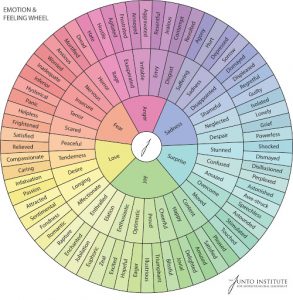
Protect space in your life to notice, identify and express your emotions.  If you struggle with knowing what emotions you are experiencing, try using this emotion wheel to give you the broader vocabulary which may help you get more specific about what you are feeling.

label emotions

Or…maybe words are not your issue, perhaps it is just not feeling connected to emotion at all.  Relying less on your brain to figure it out and more on listening to your body may help.  Just sitting quietly and scanning your body to find areas of tension, relaxation, pain, discomfort, unease or any other sensation can give you wonderful clues as to what is happening emotionally.  There are very good reasons why we lose connection to our own internal life and this is where therapy may be a great idea to build back that connection.

Action step: Experiment with a daily reminder on your phone for various times of the day: try morning, mealtimes, afternoons or bedtime.  When the alarm sounds, dedicate 10 minutes to tuning in to how you are feeling and express it in some way: draw something, find a song that matches, share it with someone or write it in a journal.  By the end of the year, you will know what techniques work and what time of day is best or you will have clarity on the fact that it is time to reach out for assistance.

Physical
Seek quality information and focus on the basics over which you have control.  Choose properly qualified sources for health information. (No, your meme-posting college friend who works in banking is not a good prospect). Look for people who are on the front lines of this pandemic – treating actual COVID patients or doing the research currently – and listen to their reports. COVID-19 was first reported on December 31, 2019 globally. Ten months is a very short period of time in the world of medicine. We have to expect the information to deepen and grow each week, so taking any kind of permanent stance on what works and doesn’t is not wise. Find good sources, listen to the information for yourself so that you can make wise decisions about your health and those with whom you come in contact.  If you have friends working in the microbiology, epidemiology or infectious disease fields, ask them for recommendations.  Here are a few resources to consider as well:

Medscape Resources

Simple model of what we currently understand regarding how the virus is transmitted. Note this is based on computer modeling and assumes a person in their most infectious stage of the virus.  The encouraging news is how effective simple strategies are against this worst-case scenario!

Laurel Bristow, Infectious Disease Researcher

Samantha Yammine, PhD – Neuroscientist/Science Communicator

Kennen Hutchison – PhD Student-Neuroinvasive Virology

Action step:  Find one or two good qualified sources for pandemic research information and do your best to minimize everything else so that you can protect yourself from panic and overwhelm.  Take a look at the basics in your life: gentle nutrition, sleep and joyful movement.  These are the things over which you have the most influence.  Determine the baby steps you can take to gain progress in those areas.

Social
Abandon ‘all or nothing’ approaches to social engagement. We need each other and so we need to be flexible in creating opportunities to connect.  We are called to physically distance – we do not have to socially distance.  It is time to let go of waiting on how it used to be.  Grieve the days that are in the rear view mirror.  The ways in which we interact – both in person and digitally are changed forever.  Change is constant.  We will have some elements of contact back someday AND we will have precautions that will stay with us indefinitely.  Many of us have refused to reckon with this reality, holding out for a return to “normal” while life passes us by in isolation.  Don’t skip the grief: the reckoning, the hurt, the fear, the anger, the sadness, the acceptance…it all must be attended to if we are to avoid the subconscious consequences.   Acceptance is hard won.  It looks like intentional strategies to regain what has been lost, from new sources.

Action step: Commit to the digital tools you may not enjoy as the price to be paid for relationship: video calls, phone calls, apps.  Feel the irritations, the frustrations, whatever difficult emotions you have and move forward anyway.  Put these digital connection appointments in your calendar so that they have a chance to slowly work their way into your normal routine.  Use the information you have gained from the science community to develop reasonable strategies for in-person gatherings.  Talk to your doctor about your unique vulnerabilities.  Discuss your decisions with friends and family and find the ones who are willing to commit to the steps required for minimizing risk to yourself and loved ones.  Make those folks members of your pandemic pod and enjoy your time together!

Would you benefit from a step-by-step walk through in applying these suggestions?  Click here to download our pacing manual!  We provide the questions and worksheets to help you identify your priorities, evaluate your media consumption, manage your emotions, improve your sleep, design your pandemic pod and prioritize your relationships.  We also provide great resources for learning more about helpful phone apps, nutrition and exercise.

GET THE MANUAL HERE

Online Adventures

Over the years, I’ve worked with a number of therapists, beginning with a licensed social worker who was also a pastor at a local church.  Each one has walked a specific section of my journey with me, facilitating insight and clarity along the way.  Soon after arriving in Orlando, I worked with two different therapists during an exceedingly challenging time of my life.  As I ended 2017 in perhaps the best mental and emotional state I had experienced in years, I paradoxically sensed it was a good time to re-enter therapy.  I was facing several positive transitions and believed I had the emotional energy to tackle foundational concepts that would help me live life from the best level possible.  Though I did not have really specific issues I needed to resolve, I did know I wanted someone who would be able to sit with and explore whatever emerged.  Trouble was, all the therapists I knew who worked like that were my friends and so could not serve in this role.  My inquires for referrals turned up absolutely nothing that met my criteria.

I remembered one of my interns telling me he had experienced useful sessions online with Victor Yalom, the son of another therapist – Irwin Yalom who I admire in my approach to therapy – especially group work.  However, I had a skeptical view of online therapy:  I’m relational in my theoretical orientation – how on earth could there be great therapy in the absence of smell, touch, and the extra-sensory dynamics of physical presence I had come to rely on in terms of perceiving what clients were feeling?  As time wore on with no emerging options, I decided it couldn’t hurt to pursue the idea, even as a second-best one, and so I contacted Victor.  Many steps later, I started working with a therapist he recommended who lived in Paris – Anastasia – in January of 2018 and it was definitely the right decision!  Here was a humbling example of what I was teaching my students: Anastasia’s ability to connect with me, to hear what I wasn’t saying, to see the patterns beneath the stories I shared, mattered more than the method we were using to talk to each other. Yes, online therapy has its differences but what mattered was the therapist and his/her ability to build a relationship with the client regardless.  Wow!

Over the following months, I put aside my biases toward online therapy and considered its benefits: to English speakers living in non-English speaking countries, to individuals committed to deeper work but lacking therapy professionals in their part of the world, to my local clients with chronic illness who sometimes struggle to make it in to the office, to individuals like me across the state of FL who are looking for a specific therapeutic fit that they cannot find close by.

I happened to be visiting Paris some time later and so I had a session in person with Anastasia. I was shocked to find that it did not feel much different from the sessions we had been doing online. It was the final push I needed to start offering what I have received: greater accessibility to this business of going deeper.  I believe my experience as an online therapy client with a therapist who does it excellently is the best qualifier for providing this service but I am still pursuing specific training and education in this particular modality to ensure that I continue to grow.

2022 edit: How could I have known the benefit of this expansion?  It prepared us to transition to a fully online practice in March of 2020!  When you engage teletherapy with Phenix, you work with a team who truly believe in this modality.  Teletherapy offers major benefits when we are willing to explore the possibilities.  Your Phenix therapists have pursued the experiences and training necessary to maximize this exciting change in how healthcare is delivered.