Confessions of a Counselor Part 1

Confessions of a Counselor Part 1

Have you ever wondered what some of the hidden benefits or struggles are with therapy? Have you ever wondered how you came into therapy wanting to reduce anxiety, and a few months later you are grieving losses from your childhood, and seeing the world differently? You see, here at Phenix, we have a strong belief in transformational work, which is why you see the word ‘transformation’ on our website and all our social media accounts. We firmly believe in the process of long-term sustainable growth and change. Not saying there is anything wrong with solution focused approaches, but generally it is not our cup of tea. Within the deconstruction and reconstruction phases of therapy, there are goals put in place by the client. In our field we call this the treatment plan. The treatment plan becomes the flight path for the focus of therapy, but other benefits and challenges come along the way.


So, onto Confession #1


There comes a point in therapy where there is a point of no return. Not that you are forced to continue the process or that you must complete some mandatory journey, rather that your eyes and mind are now more aware than ever. You cannot unsee what you’ve already seen. You cannot unknow what you now know. The joy, pain, and sadness in the world will hit you in new ways and in ways you never thought about. Just because you stop therapy does not mean the new insights stop. 


Since we are heading into the holiday season, let’s use the holidays as the scenery for this first confession. Maybe in years past you have joined your family for Thanksgiving dinner or Christmas Eve adventures, but you never were able to recognize the maladaptive behaviors and functioning of your family of origin like you do now. Maybe you begin to see and sense the sadness in your brother or mom’s eyes, even though they mask it with a smile on their face. These are the things you can no longer unsee and unfeel. Sorry. What you become aware of now causes the brain to create new neural pathways and it becomes a daily part of the ‘scanning’ your mind does. 


It is like the old cliche’ car salespeople use when you are on the lot looking to buy a car from them. They usually say something like this, “You’re gonna be seeing a lot of these on the road.” Yea, that’s because they know your mind is now wired to be looking for the same new car/SUV as you wander down the highway. The car/SUV was always there roaming the roads with you, but they never stuck out to you because your mind never had a reason to cause it to come to your consciousness. Now it does. Has this ever happened to you? Where you went to the Ford dealership to check out a Mustang and now you see every new Ford Mustang on the ride to work. You cannot unsee the Mustangs….they’re everywhere ha. 

Again, my apologies… sorta. Awareness is a part of the journey. Gaining awareness and insight into your functioning is amazing. It gives you the power and control back in your life to begin choosing new ways of responding, behaving, etc. The more you become aware of, the more you can change. The more you realize you can change, the more hope you have of a brighter future, and after the last couple years, I think some extra hope is a good thing. Join me next week for confession #2.

Maximizing Therapy

Person engaging in teletherapy

Have you wondered why excellent therapy can seem expensive?

Do you want to get the most out of the therapy process?

By the time a new therapist graduates from their masters program, they have spent more than 600 hours in graduate level classrooms taking courses dedicated to the art of helping people with life problems.  They have sweated almost 2000 hours on homework and completed 1000 hours of supervised internship.  All at a price tag of over $35,000 (minimum).  Upon graduation, they must work under supervision for at least two years, complete an additional 1500 hours of client service and pass a national competency exam.  When you show up in a therapist’s office, or log on to their teletherapy platform, you are meeting with a highly trained clinician who is there to help you reach your mental, emotional, and relational health goals.

Therapy is an investment in your future.  Since insurance companies will not cover therapy for life issues (there must be a mental health diagnosis), many pay for this vital care out-of-pocket.  Even with support for the cost, there is a significant investment of time establishing rapport with a therapist and digging in to the work.  With that in mind, here are tips for getting the most bang for your ‘buck’!

At Phenix, we generally follow a steady arc in therapy: establishing safety, deconstruction of the old story (how did we get here?), grieving and then constructing the new story.  We’ll look at tips for each stage but before we go there, here’s a foundational principle:

Recognize that therapy is just one hour out of 168 or one hour out of 336 if sessions are biweekly!  Clearly, a lifetime of thinking and behaving a certain way will not be fixed in such short bursts.  That means we must be ready to dedicate time outside of sessions to working on ourselves.

Establishing Safety –

  • Now is the time to be ruthless in clearing off your ‘plate’: Respectfully withdraw from commitments you don’t absolutely have to participate in.  Notify your friends and family that you will not be as available as before.  Setting boundaries poorly may be why you’ve come to therapy so this is a tough one.  Make short term changes (like putting off involvement in something for a few weeks instead of saying “no” all together) which will buy you time to build the muscles you’ll need for more sustainable transformation.
  • Focus on the basics: sleep, nutrition and movement.  Again, the point of therapy may be to get better at self care so take baby steps for now.  Try to get to bed at a consistent time, decide what you need to add to your diet (not take away) to feel good and find movement you actually enjoy – even if it is just for 10 minutes.
  • Be honest with your therapist.  Now is the time to share your concerns so that you can establish a strong working alliance.  They are your guides on what will be a difficult journey at times.  It is important you establish trust in their expertise and skill.
  • Try out the coping skills you and your therapist discuss so that you can determine what works for you and what doesn’t.  You don’t want to wait until you are in the thick of the process to figure this out.  Everybody is different and the possibilities are endless, so there is no substitute for testing things out.

Deconstruction of the old story –

  • Spend time between sessions reflecting on what you have discussed.  Your therapy hour is just the beginning of making sense of your story and connecting the dots as to why you think and/or behave the way you do.
  • Review the material your therapist gives you (books, podcasts, videos, etc.).  This is part of the process for understanding how you got to where you are.

Grieving –

  • Lean in to the discomfort.  This stage takes courage.  This is the stage when clients most often resist the therapist.  Despite the strong alliance they have built and the trust that has been established, all of a sudden, “maybe my therapist isn’t so great after all.  Why are they torturing me with this work?”  Trust the process, it will be worth it!
  • Avoid working on your process after dinnertime each day.  The end of your day should be spent winding down, not opening up Pandora’s box of emotion.
  • Experiment until you find a rhythm of self work time that works for you.  Perhaps a one-and-done session each week when everyone knows not to disturb you or maybe 20 minutes each morning.  It doesn’t matter the format – what matters most is consistency.

Constructing the new story –

  • This stage is about literally rewiring the brain.  That means your efforts will feel awkward and counter-intuitive and that is OK.
  • Your sessions will involve either learning new skills that you will need to cultivate on your own or generating plans for handling situations differently than you have before.  It’s all about action at this point so remind yourself constantly that different results demand different strategies.
  • Practice, practice, practice.  Practice makes progress.  Commit to take one baby step forward each day.  Nothing changes by coming to therapy and talking about it.  It changes when you leave the session and do things differently.  Therapy helps you break this down into manageable baby steps and strategize the most effective changes.

An excellent auto mechanic can easily garner upwards of $100 per hour to fix our cars.  We would consider it foolish to pay for their expertise, then do nothing to maintain the vehicle or prevent further issues.  Our health is far more valuable than our cars so we hope that this post inspires you to invest in yourself and maximize that investment for the best return!


Sneakers and Mental Health

Do you have sneakers/cleats you no longer wear or that just never felt comfortable?  Want to avoid adding to our exploding landfills?  Would you like to help provide excellent mental health care to your neighbors? 

Have we got an easy plan for you!  Drop those shoes off at one of two locations during the month of May.  When we turn them in to the agency that collects them, we will receive a small payment for each shoe (every little bit adds up!) that will be added to our scholarship fund.

Drop off locations are:

  1. Firefly Yoga Studio (Ocoee location)

Mondays between 8:15am and 6:15pm

Tuesdays & Thursdays between 6:15am and 7:30pm

Wednesdays between 9:45am and 6:15pm

Fridays between 9:45am and noon

Saturdays between 8:15am and 9:45am

Shoe contributors will receive a coupon for one free class (Limit one coupon per person)

2. Joy Performing Arts in Oviedo

Mondays – Thursdays between 11am and 8pm

Saturdays between 9am and 1:30pm

(Closed memorial day weekend Friday-Monday

Shoe contributors will receive a coupon for one free class (Limit one coupon per person)

If you’ve been following us for any length of time, you know that as a team, we are passionate about service.  Not only do we get hands on in the community, but as a company – we maintain our commitment to service through: 1) Each counselor keeping one client spot dedicated to a person who pays what they can afford.  In this case, the counselor & practice absorb the financial loss.  2) A percentage of net profit is ear-marked for a scholarship fund that will enable recipients to obtain therapy at whatever fee they can pay.  The difference between their payment and the counselor’s fee will be drawn from the scholarship fund.

2020 didn’t go according to plan when it came to reaching our fund goal but we are on track to start disbursing in July of this year!!  To help the process along, we brainstormed ideas for fund raising and came across this sneaker idea which we love because it’s a win-win: not only do we generate funds but we also contribute to good stewardship of the planet.

We have had supporters offer to donate directly to this fund once they heard about it but we had not set up a way to make this happen.  Now we have a link!!  Please know that Phenix is not a 501c3 organization.  With the tax law changes in 2018 which effectively made itemized deductions no longer worthwhile for the average taxpayer – we cannot justify the cost of setting up a non-profit organization for the scholarship fund.  We would rather put every penny directly into covering counselor fees…  That said, if you would like to donate directly to the scholarship fund – just click the link below.  We have set it up to clearly mark the transaction as a fund donation so it is allocated correctly.

CLICK HERE TO DONATE TO SCHOLARSHIP FUND

Pandemic Combustion Prevention


Illustrate combustion

Have you about reached your limits after almost 8 months of chaos? Most of us began this season in March with some level of anxiety but a commitment to be careful and a belief that “this too shall pass”. Well. It hasn’t quite gone that way, has it? Not only are we staring down the barrel of a resurgence as winter approaches (something the experts predicted back in April), but add in social unrest, election vitriol and a complete breakdown of societal support and structure across every level. While folks have developed a routine of one foot in front of the other to get through our days, even those of us privileged enough to still have a job with the freedom to work from home, are beginning to realize that our gas tanks are near empty. With no end in sight, what is the plan?

It is time to stop and be strategic. As much as we would love to believe in the magic of a new year, 1/1/2021 will not bring with it any major changes. We are looking at more of the same for many months to come. In the coming weeks, we are supposed to figure out how to celebrate holidays without putting ourselves or others at undue risk. Not to mention – find the energy to do so. As mental health professionals, we’ve been observing all of this and feeling compelled to bring reasonable strategies to the table along with specific action steps that we can focus on as we bring this year to a close.

Mentally
Treat your brain like your favorite recipe – the ingredients you put in determine the end product. 
What are your priorities in life? Is it a mission you are called to; a role that you value – leader, spouse, parent; a set of spiritual values?  What are the concepts bigger than you which should drive the way you do life?  Once you have clarity on priority – become a diligent curator of everything you consume!  The websites you visit, the people/accounts you follow on social media, the shows you watch, the books/articles you read, the videos you watch, the podcasts you listen to, the music you play…take a militant stance toward each and every ingredient being deposited in your brain.  Does each one align with the priority you identified?  If the ingredients don’t match up, the dish you end up with will not have any resemblance to what you claim to be of importance to you.  Remember quality matters as well.  Marinara made with grocery store tomatoes cannot compare to the sauce made with heirloom tomatoes from grandma’s backyard, right?

Action step: Spend a week making note of everything you take in, then sit down and make decisions about what needs to go and what ingredients are missing in light of what matters most to you.

Emotionally
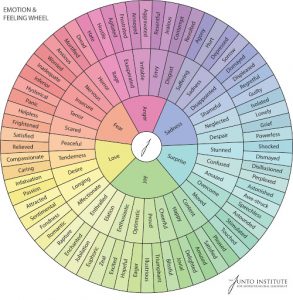
Protect space in your life to notice, identify and express your emotions.  If you struggle with knowing what emotions you are experiencing, try using this emotion wheel to give you the broader vocabulary which may help you get more specific about what you are feeling.

label emotions

Or…maybe words are not your issue, perhaps it is just not feeling connected to emotion at all.  Relying less on your brain to figure it out and more on listening to your body may help.  Just sitting quietly and scanning your body to find areas of tension, relaxation, pain, discomfort, unease or any other sensation can give you wonderful clues as to what is happening emotionally.  There are very good reasons why we lose connection to our own internal life and this is where therapy may be a great idea to build back that connection.

Action step: Experiment with a daily reminder on your phone for various times of the day: try morning, mealtimes, afternoons or bedtime.  When the alarm sounds, dedicate 10 minutes to tuning in to how you are feeling and express it in some way: draw something, find a song that matches, share it with someone or write it in a journal.  By the end of the year, you will know what techniques work and what time of day is best or you will have clarity on the fact that it is time to reach out for assistance.

Physical
Seek quality information and focus on the basics over which you have control.  Choose properly qualified sources for health information. (No, your meme-posting college friend who works in banking is not a good prospect). Look for people who are on the front lines of this pandemic – treating actual COVID patients or doing the research currently – and listen to their reports. COVID-19 was first reported on December 31, 2019 globally. Ten months is a very short period of time in the world of medicine. We have to expect the information to deepen and grow each week, so taking any kind of permanent stance on what works and doesn’t is not wise. Find good sources, listen to the information for yourself so that you can make wise decisions about your health and those with whom you come in contact.  If you have friends working in the microbiology, epidemiology or infectious disease fields, ask them for recommendations.  Here are a few resources to consider as well:

Medscape Resources

Simple model of what we currently understand regarding how the virus is transmitted. Note this is based on computer modeling and assumes a person in their most infectious stage of the virus.  The encouraging news is how effective simple strategies are against this worst-case scenario!

Laurel Bristow, Infectious Disease Researcher

Samantha Yammine, PhD – Neuroscientist/Science Communicator

Kennen Hutchison – PhD Student-Neuroinvasive Virology

Action step:  Find one or two good qualified sources for pandemic research information and do your best to minimize everything else so that you can protect yourself from panic and overwhelm.  Take a look at the basics in your life: gentle nutrition, sleep and joyful movement.  These are the things over which you have the most influence.  Determine the baby steps you can take to gain progress in those areas.

Social
Abandon ‘all or nothing’ approaches to social engagement. We need each other and so we need to be flexible in creating opportunities to connect.  We are called to physically distance – we do not have to socially distance.  It is time to let go of waiting on how it used to be.  Grieve the days that are in the rear view mirror.  The ways in which we interact – both in person and digitally are changed forever.  Change is constant.  We will have some elements of contact back someday AND we will have precautions that will stay with us indefinitely.  Many of us have refused to reckon with this reality, holding out for a return to “normal” while life passes us by in isolation.  Don’t skip the grief: the reckoning, the hurt, the fear, the anger, the sadness, the acceptance…it all must be attended to if we are to avoid the subconscious consequences.   Acceptance is hard won.  It looks like intentional strategies to regain what has been lost, from new sources.

Action step: Commit to the digital tools you may not enjoy as the price to be paid for relationship: video calls, phone calls, apps.  Feel the irritations, the frustrations, whatever difficult emotions you have and move forward anyway.  Put these digital connection appointments in your calendar so that they have a chance to slowly work their way into your normal routine.  Use the information you have gained from the science community to develop reasonable strategies for in-person gatherings.  Talk to your doctor about your unique vulnerabilities.  Discuss your decisions with friends and family and find the ones who are willing to commit to the steps required for minimizing risk to yourself and loved ones.  Make those folks members of your pandemic pod and enjoy your time together!

Would you benefit from a step-by-step walk through in applying these suggestions?  Click here to download our pacing manual!  We provide the questions and worksheets to help you identify your priorities, evaluate your media consumption, manage your emotions, improve your sleep, design your pandemic pod and prioritize your relationships.  We also provide great resources for learning more about helpful phone apps, nutrition and exercise.

GET THE MANUAL HERE

Online Adventures

Over the years, I’ve worked with a number of therapists, beginning with a licensed social worker who was also a pastor at a local church.  Each one has walked a specific section of my journey with me, facilitating insight and clarity along the way.  Soon after arriving in Orlando, I worked with two different therapists during an exceedingly challenging time of my life.  As I ended 2017 in perhaps the best mental and emotional state I had experienced in years, I paradoxically sensed it was a good time to re-enter therapy.  I was facing several positive transitions and believed I had the emotional energy to tackle foundational concepts that would help me live life from the best level possible.  Though I did not have really specific issues I needed to resolve, I did know I wanted someone who would be able to sit with and explore whatever emerged.  Trouble was, all the therapists I knew who worked like that were my friends and so could not serve in this role.  My inquires for referrals turned up absolutely nothing that met my criteria.

I remembered one of my interns telling me he had experienced useful sessions online with Victor Yalom, the son of another therapist – Irwin Yalom who I admire in my approach to therapy – especially group work.  However, I had a skeptical view of online therapy:  I’m relational in my theoretical orientation – how on earth could there be great therapy in the absence of smell, touch, and the extra-sensory dynamics of physical presence I had come to rely on in terms of perceiving what clients were feeling?  As time wore on with no emerging options, I decided it couldn’t hurt to pursue the idea, even as a second-best one, and so I contacted Victor.  Many steps later, I started working with a therapist he recommended who lived in Paris – Anastasia – in January of 2018 and it was definitely the right decision!  Here was a humbling example of what I was teaching my students: Anastasia’s ability to connect with me, to hear what I wasn’t saying, to see the patterns beneath the stories I shared, mattered more than the method we were using to talk to each other. Yes, online therapy has its differences but what mattered was the therapist and his/her ability to build a relationship with the client regardless.  Wow!

Over the following months, I put aside my biases toward online therapy and considered its benefits: to English speakers living in non-English speaking countries, to individuals committed to deeper work but lacking therapy professionals in their part of the world, to my local clients with chronic illness who sometimes struggle to make it in to the office, to individuals like me across the state of FL who are looking for a specific therapeutic fit that they cannot find close by.

I happened to be visiting Paris some time later and so I had a session in person with Anastasia. I was shocked to find that it did not feel much different from the sessions we had been doing online. It was the final push I needed to start offering what I have received: greater accessibility to this business of going deeper.  I believe my experience as an online therapy client with a therapist who does it excellently is the best qualifier for providing this service but I am still pursuing specific training and education in this particular modality to ensure that I continue to grow.

2022 edit: How could I have known the benefit of this expansion?  It prepared us to transition to a fully online practice in March of 2020!  When you engage teletherapy with Phenix, you work with a team who truly believe in this modality.  Teletherapy offers major benefits when we are willing to explore the possibilities.  Your Phenix therapists have pursued the experiences and training necessary to maximize this exciting change in how healthcare is delivered.

Whitespace

At the GLS event I mentioned a couple of months ago, I heard Juliet Funt speak on the concept of “whitespace“: that business of intentionally creating a space for NOTHING so that creativity can emerge in the workplace.  An excellent reminder and validation of my love for this concept in our personal lives.  Our culture is driven by the need for constant activity and most of us are completely enslaved to the merry go round.  There are two main traps we tend to fall in for this obsession with activity: The trap of achievement – believing that we are only as worthwhile as our productivity…hence there’s never a time we can feel at peace when we are still.  Or, there is the trap of emotional avoidance.  Sitting still becomes a dangerous dynamic to be avoided at all cost because it allows one’s pain and anxiety to emerge!   Often, you’ll hear folks caught in these traps exclaim, “Oh, I have no time for that”, or “Oh my goodness, I would go crazy sitting around doing nothing” when presented with the idea of rest, retreat, white-space.  I chuckle internally when I hear these tell-tale words.

The reality is, we absolutely need quiet time in order to grow.  There’s the irony – so often, we go, go, go because we’re trying to achieve, to progress, to accomplish.  All the while, in the absence of appropriate down-time, we’re actually moving backward.  Often, without realizing it until it’s too late.  The epiphany typically arrives in the form of physical illness because our bodies keep score and when we ignore it’s need to rest and recuperate, it eventually takes its revenge.

My focus today though is the emotional aspect.  This blog is about personal transformation.  With that in mind, where does white-space fit in?  Transformation begins with awareness, continues with learning and is then cemented by action.  In order for new learning to be integrated, it must be consolidated – a process that cannot happen during activity.  It only happens during times of quiet.  Have you ever noticed that you attend an amazing workshop where you learn great concepts but weeks later, you’re struggling to remember what you found so revolutionary?  Or, perhaps you pulled an all-nighter in college, studying for a big test and then drew a complete blank on so much during the exam?  These are examples of what happens to learning without white-space.  If we do not take the time to STOP and reflect on our new awareness, understanding and insight, we don’t retain it.  We don’t act upon concepts we don’t retain and thus, we stay stuck in patterns of dysfunction.

When clients have covered a lot of territory in session, I always warn them to take some downtime within the next 24 hours to let their work consolidate.  Eventually, I teach them to build this space into their regular routine so that there is ongoing room to grow and they don’t have to scramble for it when life brings them new opportunities.  Personally, I try to model this in my own life, regularly spending time in nature.  This week, during a quick trip to GA, I asked my host about the local parks and was guided to a fabulous nature trail.  My friend and I remarked how just one hour on the trail made such a difference in our mental outlooks…not to mention how much better our bodies felt after hours of driving the day before.

You may find yourself resonating with these words, making promises to yourself to find more white-space in your life but if you are caught in one of the two traps I mentioned, it’s easier said than done.  Your source of worthiness must be addressed if you are to ever make peace with stillness.  You must acquire the skills of emotion management if you are to become willing to let frightening feelings emerge.  Likely, you have specific family stories that have left you ill-equipped or believing lies that will forever hold you back.  If you don’t know how to work on cars, don’t you take your vehicle to a mechanic?  If you never learned to work on appliances, don’t you call a repair company for your broken refrigerator?  Yet somehow, when we recognize a gap in our mental or emotional skills, we hesitate to contact a therapist who is trained in the very skills we lack.  Strange, isn’t it?  Consider breaking that trend and give us a call if you realize your struggle to create white-space goes deep into territory you haven’t yet mastered!

The mechanics of change

I am sitting in a hostel in Brussels, Belgium at this moment – taking some down time to rest before heading out for the evening.  I’ve been away from home now for four weeks and I can definitely testify that leaving one’s comfort zone for extended periods of time facilitates much internal transformation.  Next week, I’ll write more specifically about that.

Today, I’m reflecting on a conversation I recently had with my travel companion about the process of change.  When we decide to renovate some major area of our lives, what does that look like from the inside?  Going to a counselor is usually reserved for more significant repairs, so this question would certainly pertain to current or future clients.  I answered from my own personal experience though.  One of the core values of Phenix Counseling is that I cannot take anyone where I have not personally gone (in terms of the process of facing our own shadow selves).

So for me, it begins with awareness.  Recognizing not only the problem, but also (usually with the help of another), how I am contributing to the problem.  What is it about me exactly that is facilitating the pattern and how did I come to be that way?  I need this insight in order to have productive conversations with myself and that is pretty much the meat and potatoes of the change process for me.  Let me break it down:

  • When I figure out the past experiences that led to my current way of approaching things and what meanings I made of those past experiences, I can choose a new perspective that will give me the motivation and logic to take a different path in the here and now.
  • Looking at the question of – how did I come to be this way…why am I behaving dysfunctionally – helps me understand myself enough to figure out what need I’m trying to meet.  I have to brainstorm ways to meet that need in a healthier way if I am to have any hope of success. I turn these ideas into practical plans: what will do instead, when and how will I make that happen?
  • Then….the rubber meets the road.  Real life sets in and change comes down to tiny moments of decision we face in the everyday.  Here’s where that constant conversation with self comes in.  It’s a messy process and it took me a little while to try and explain it.  At first, I catch myself “after the fact”.  I resort to my old ways but at least I realize it soon after.  Then…I start to catch myself during the process.  I remember when I decided to relate to my husband differently, there were times when words from my old perspective would be coming out of my mouth but in my head I would be thinking, “you need to stop talking”.  Yet somehow…the word vomit continued and I was faced with cleaning up the mess afterward.  Then comes the ability to choose my new strategies before I mess it up.  This begins to happen more often than not until I solidify my new way of being.

Of course, it never happens in this linear fashion – I circle around and through these stages in no particular order until I establish some sort of stability.  Oh how I wish it was like the one-way journey of the caterpillar to the butterfly!  All of this has to happen within the context (cocoon) of others who can help me analyze and assess my thoughts and behaviors throughout the process and with folks who have the patience and ego strength to be on the receiving end of my changes.  I am blessed to have that kind of environment and often, I find the greatest work in therapy is helping my clients build such a support system before they can tackle the things they need to change within themselves.

I hope this little window into my world helps those who struggle to become who they are meant to be.  Our journeys are unique – others would describe their process differently but I believe the commonalities are the mess and the time it takes to cross the desert of transformation – it’s always longer than we planned.  Wherever you are in that trip, be encouraged and don’t skimp on the task of ensuring you have solid travel partners!

Necessary Endings

I stole the title of this post from a great book.  It perfectly captures a phenomenon I’ve been living out personally and that I see in the lives of my clients quite often: This business of hanging on to relationships far beyond their expiration date.

Why do we do this?  The short answer is fear, but let’s break it down more specifically:

Fear of rejection: how many times do we fail to set boundaries, fail to verbalize what is ok or not ok for us because we are afraid that when we do that, the other will reject us? They will not want to be in relationship with us.  Which leads us to the next fear…

Fear of being alone: many of us believe that anyone is better than no one.  We cannot fathom how we could ever be happy by ourselves and so we tolerate all kinds of shenanigans because we cannot be alone.

Fear of violating our responsibility or duty: For a million and one reasons, we feel obligated to the other to “help” them and/or not abandon them.  Anything from blood ties to our own sense of ethics to nice things they did in the past.  Whatever the reason, we use it to justify staying in the relationship because we “have” to.

Fear of hurting another: We are terrified of ever hurting our loved one’s feelings and so we hold back our truth.

So what’s the remedy?

Self worth: when we understand our worth, we cannot help but protect ourselves from dysfunction, even if that results in rejection.  It’s like the difference between a diamond versus a cubic zirconia ring.  The lengths you go to for protection and care of the diamond far exceed that of the CZ ring, simply because of the difference in worth between the two.

Self love: When we take the time to get to know who we truly are and develop compassion and grace toward ourselves, we enjoy our own company…we feel secure in our own skin.  From that place, we realize that while relationships are vital, tolerating any individual who violates our worth is unacceptable and being alone for a season is perfectly fine.

Responsible to, not for: We have a responsibility within our community to monitor our own thoughts, feelings and behaviors to be authentic and kind.  We are never responsible for though – anyone else’s thoughts, feelings or behaviors.  The only partial exception is in our role as parents where we are responsible for them to a certain extent but even in that, our kids have free will to make their own choices and must experience the consequences of those choices if they are to learn how to operate as adults.  There is a big difference between that “to” and “for”, so there is never a situation where it is healthy for us to stick around tolerating dysfunction in order to keep someone from thinking, feeling or behaving a certain way.

Hurt versus harm: When we go to the dentist with a problem, it is pretty much a guarantee that whatever is done to fix us will hurt.  While they make a diligent effort to prevent unnecessary pain, they don’t avoid their work just because some pain will ensue. What they do have to worry about is harming the patient.  If they are negligent or flat out unskilled, they can make mistakes that cause permanent damage to someone’s mouth and that is harmful.  Likewise, when we have to walk away from relationships, there will be hurt and that’s not a bad thing.  What we don’t want is to conduct the leaving in a way that is hateful, disrespectful or deceitful.

These remedies may make all kinds of sense but they are much easier said than done!  Our view of self is rooted in our experiences – particularly those of our early years and it is no small task to change the meanings we have made of those experiences.  Dealing with the inevitable guilt we feel when we begin to set healthy boundaries can be enough to turn us back to our old ways.  If you struggle with taking these steps toward health, seek out a counselor who can help you dive under the struggle to address the foundational meanings driving your resistance!


Doing

Experience is the greatest teacher they say…  Whatever dysfunctions we have going on in our lives (and yes, we all have some) – we come by them honestly.  None of us wakes up one morning and decides to be defensive, destructive, avoidant, etc. for no reason.  We approach life based on the experiences we’ve had and the meanings we’ve made of them.  When those meanings are no longer functional, that’s where therapy comes in.  Together, we explore past experiences and how we interpreted them to identify the sticking points that cause negative results today.  Then, we work together to re-examine those experiences and expand the meanings to understandings that lead to more positive ways of doing life.  The healthy relationship formed in therapy provides a model for the rest of life and offers a safe base from which to go out and change our worlds for the better.

The work done in the therapy room is not effective without implementation into daily life.  Healing requires doing.  We must test out our new meanings, creating new experiences that will cement those meanings in our hearts and not just our brains.  This is the terrifying part.  It can be so comforting and enlightening to have ah-ha moments in therapy.  “Whaaat?!  That’s why I’ve always done that?  Oh my gosh, this totally makes sense now!”  Those insights are wonderful and make for much internal relief and de-stressing.  But then….we have to act “as if”.  If this new understanding is true, what do I do differently?  This is where the terror comes in because it is a great act of vulnerability to go out into an unchanged world with our changed selves and trust that we will be successful.

Sometimes, this becomes a stumbling block for clients.  It could be because we need to do more work on our own internal anxiety before we can take action.  Often though, it is due to confusion about how to actually handle things differently.  Isn’t it normal to need some practice with a new skill before we use it ‘for real’?  This very basic truth about learning is why I believe therapy has to be active.  Perhaps the most common technique is to role play anticipated situations/conversations.  That is an incredibly valuable exercise as we get to form new words and even hold our bodies in different positions than we have before.

I am finding though, that there are plenty of additional ideas for experiential learning.  Last week, I joined a team of colleagues at WinShape to participate in team building exercises with a facilitator who happened to be a therapist.  As we funneled tennis balls through short plastic tubes, held mousetraps in our joined hands, and moved a bowling ball without touching it, I saw so many connections between these activities and the principles that clients are often struggling to implement in their lives:  Creative problem solving, collaboration, trust, believing they can do hard things, believing it is possible to do things differently than before, etc.  Our activities culminated with a climb to the top of what they refer to as the “Pamper pole”.  I’ll let you imagine why it has garnered that name.  Let me just say that I have not experienced that level of terror in a very long time!  Conquering it was the best thing that could have happened though, at a time in my life when I’ve been questioning my ability to rise to the amazing mission unfolding before me.  It gave me absolutely tangible proof that I can dominate and that has already provided energy to move forward with the hard things.  There is nothing like actual success to fuel further success.  The same techniques I used to get through the exercises at WinShape are the same techniques I will use to power through the obstacles I face in the rest of my life.  That is how this works.

I am so excited to bring these kinds of activities back to my clients.  Not just individual sessions, but family sessions, groups and especially corporate workshops.  I have a passion for leadership development and building corporate culture, so this approach fits perfectly!  I do promise however, not to utilize 30 foot telephone poles 🙂

Weary

If you read last week’s post, you know that sleep has been an “issue” for me lately.  Generally speaking, exhaustion has been my constant companion.  At first, I chalked this up to the aforementioned backsliding on sleep hygiene.  But…in my heart I knew there was more to the story.  There always is.

There is a popular metaphor about the frog in boiling water.  The story goes that if you put a frog in a pot of cold water, set it on the stove and turn on the heat…the frog will stay in the water as it continues to get hotter.  Apparently, the gradual rise in temperature is not something it notices and eventually, it will literally boil without ever jumping from the pot as it is free to do.  Now, let’s put aside the very reasonable question of who discovered this awful truth and why.  The point is, it illustrates how we can get so normed to dysfunction or negative circumstances/emotions that we remain oblivious to its dangers.

As I pondered this season of exhaustion and wondered what in the world was wrong with me, I realized that my daughter’s birthday is March 2nd.  Those who know me, realize exactly what that means.  Words cannot describe how much that little girl was the center of my world and what trauma it meant to lose her 22 years in.  How could my body not remember the process of giving life to this central figure?  How could it not mourn the absence of whom it had birthed?  You see…that’s the thing.  The body remembers.  Often, when sleep is elusive, it is absolutely connected to emotional traumas.  What that means is that sleep hygiene becomes even more important as a means of tender loving care for these wounds.  There is no healing without rest.  At the same time, there is no rest without healing so facing the emotional traumas is a must.  And so, I make space to hold.  Wednesday morning, I will head to Sholom Park in Ocala with a dear friend.  It will be a time for reflection.  A time to honor Christina’s memory and to check in with my own grieving process.  It has been five and a half years.  It would be easy to take this process for granted.  To be that frog in the ever hotter water.  To flip the auto pilot switch on which – to be honest – I do much of the time at this point.  However, grieving a child never ends and I must set aside time to reconnect with it.  In the meantime, I treat myself with grace.  I value my imperfection, my brokenness and I seek out people and environments who do the same.

Your sleep difficulties are probably not related to the loss of a child.  However, I am willing to bet money (and I am not a gambler) that you have your own unique story of pain and longing that lurks beneath the surface of insomnia.  Take the steps, yes, to develop a better bedtime routine but do not be fooled – attention must be paid to your emotional health so give some thought to how you will address that.  Keep in mind that you may not remember the relevant factors right now.  Just this morning, I remembered another crucial anniversary that is absolutely contributing to my exhaustion.  One associated with much heartache.  How the heck could I have forgotten that?  I am a therapist…I specialize in these connections!  So there you have it, none of us are immune to these dissociative habits that we develop to keep ourselves protected.  The brain is an amazingly complex and tricky son of a gun.  Venturing into its depths is not for the faint of heart and seriously not a journey to take alone!  If you’re ready to get to the root of sleep difficulties…enlist a qualified wilderness guide.  I promise it is one of the scariest, yet best decisions you’ll ever make!